|
Pick established the operation’s headquarters at Omaha District, where he coordinated the activities of personnel in the Omaha, Garrison, and Denver districts and in existing and new area offices in Nebraska, Wyoming, and the Dakotas. Corps personnel from nearby dam projects, Fifth Army officers experienced with heavy equipment, and twenty-five officers from the Engineer School at Fort Belvoir arrived to assist. The Navy created a radio network to keep communications open. Soon the Air Force’s Operation Haylift and all state, local, and Red Cross rescue and relief efforts fell under the Snowbound umbrella.
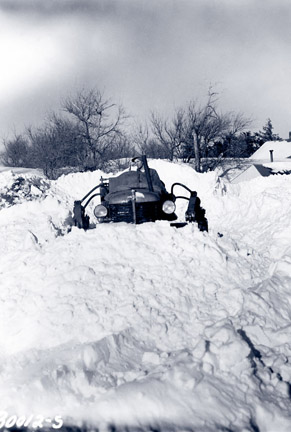
The responders used aircraft to perform reconnaissance and drop supplies. Army Weasels ran atop the snow to bring supplies to stormbound residents. Following behind were mobile strike forces made up of bulldozers, snowplows, fuel trucks, wreckers, tractors, and cargo vehicles. At its peak, 6,237 people participated in the effort, including 807 Army officers, 959 Corps employees, and over 4,000 contractors. They used 1,654 pieces of snow-clearing equipment in a disaster area covering 193,000 square miles with an estimated population of 1.2 million.
Those in the field faced hazardous conditions—high winds that blew granular snow and splinters of ice, extreme cold that caused frostbite, and drifting snow that often blocked roads behind them. Several suffered from snow blindness, and one soldier and six civilians died in accidents. Lt. Richard Hartline and Corporals John Donnelly and Melvin Shoemaker of the Corps of Engineers received the Army Commendation Ribbon for their efforts in Snowbound, the first disaster response mission for which the ribbon was awarded. On 15 March 1949, Operation Snowbound came to a successful end. The personnel involved had opened over 115,000 miles of roads, freed over 240,000 trapped people, and fed over four million head of livestock.
|
|
 |